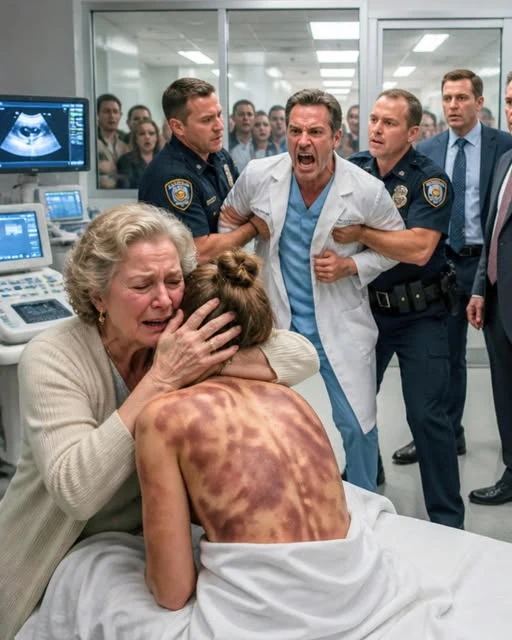
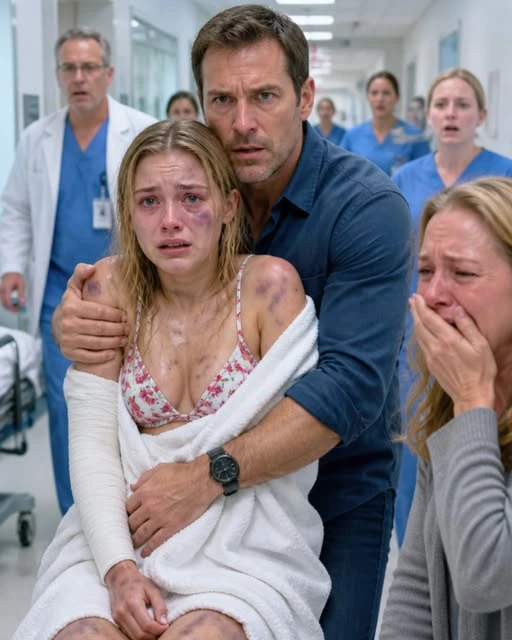
My stepfather beat me every day as a form of entertainment. One day, he broke my arm, and when we took me to the hospital, my mother said, “She accidentally slipped and fell while bathing.” As soon as the doctor saw the bruises on my face, he immediately called 911.
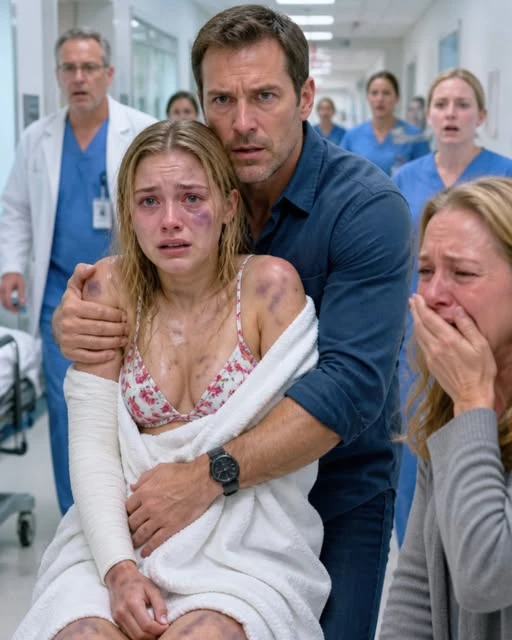
My stepfather beat me every day as a form of entertainment. One day, he broke my arm, and when we took me to the hospital, my mother said, “She accidentally slipped and fell while bathing.” As soon as the doctor saw the bruises on my face, he immediately called 911.
PART 1
The day my stepfather broke my arm, my mother lied faster than I screamed. She held my good wrist in the hospital lobby and whispered, “Cry wrong, and you’ll never see sunlight again.”
I was seventeen, small enough for them to call me weak, old enough to know the difference between a house and a cage. My stepfather, Thomas Vance, liked to beat me after dinner. Not because I talked back. Not because I failed school. He did it because he enjoyed watching fear change my face.
“Dance, little orphan,” he would say, circling me with a beer in his hand while my mother sat on the couch, scrolling through her phone like I was a loud commercial.
My real father had died when I was nine. He left me two things: his last name and a locked cloud account full of old family videos. At least, that was what everyone thought. Thomas thought Dad had left me nothing useful. Mom thought I was too broken to remember passwords.
They were both wrong.
For years, I learned silence the way other girls learned makeup. I learned which floorboards creaked. I learned where Thomas hid his cash, where Mom kept her forged signatures, and how their voices changed when they were lying. I learned to record without looking like I was recording.
An old phone, cracked at the corner, stayed hidden behind a loose vent in the living room. Another one lived inside a cereal box on top of the fridge. Every slap, every threat, every laugh after pain—saved, uploaded, backed up.
I didn’t use it yet. I was waiting for someone outside that house to look at me and believe what they saw.
That night, Thomas twisted my arm until something snapped. Mom’s face went white for one second, then hard again.
“Bathroom,” she said sharply. “You slipped.”
At the hospital, she smiled at the nurse. “She’s clumsy. Always has been.”
The doctor came in ten minutes later. Dr. Alexander Reed. Calm eyes. Careful hands. He looked at my arm, then at the yellowing bruises near my jaw, the finger marks fading on my neck.
He didn’t ask my mother anything. He looked straight at me and said softly, “Did you fall?”
My mother squeezed my wrist.
I raised my eyes. “No,” I said. “I survived.”
Dr. Reed stepped out. Thirty seconds later, he called 911...
PART 2 — THE HOUSE THAT HAD BEEN LISTENING
The first police siren reached the hospital before my mother had time to invent a second version of the truth.
Its cry rose through the rain, sharp enough to cut through the emergency-room walls. My mother released my wrist. For one second, she looked less like the woman who controlled every breath in our house and more like someone who had heard a locked door closing behind her.
“What did you say to him?” she whispered.
I studied the red marks her nails had left.
“Enough.”
Two officers entered with a woman in a charcoal coat. Detective Serena Vale did not question me immediately. First, she asked a nurse to take my mother into another room.
“She is a minor,” my mother snapped. “I stay.”
Dr. Reed stepped between us.
“No,” he said calmly. “You don’t.”
My mother lifted her chin. “She lies. She hurts herself for attention.”
Dr. Reed looked at the X-ray glowing on the wall.
“This fracture was caused by rotational force. It did not happen in a bathtub.”
An officer escorted her out. As she passed, she leaned close enough for her perfume to cover the antiseptic.
“You have destroyed your life.”
For the first time, I held her gaze.
“No. I stopped you from destroying the rest of it.”
After she left, my body shook. My bones had spent years preparing for punishment; they did not yet understand that the person who punished me was gone.
Detective Vale placed a recorder on the tray.
“You control this conversation. Stop whenever you need to.”
No adult had ever said those words to me.
“My name is Elena Mercer,” I began. “I’m seventeen. Thomas Vance has hurt me for years. My mother knows.”
“Is there evidence?”
“Two phones. One behind the loose vent in the living room. One inside the cereal box above the refrigerator. Everything uploads automatically.”
“To where?”
“My father’s cloud account.”
Dad had taught me that a password should be a memory no one else knew how to enter. His account opened with the sentence he whispered whenever storms frightened me:
The stars remember what the house forgets.
Detective Vale asked why I had waited so long.
“Because proof is useless if the person holding it disappears,” I said. “Thomas checked my room, my backpack, even the hems of my clothes. I needed the recordings somewhere he couldn’t reach.”
She asked how often he hurt me.
I counted the way I counted ceiling cracks during beatings.
“Most nights after dinner. Sometimes in the morning if he had been drinking. My mother watched. Once, she turned up the television because the neighbors were outside.”
The nurse beside me stopped writing for half a second.
That pause mattered. It meant the horror was no longer ordinary just because it had happened often.
Detective Vale sent officers to our address and placed security at every hospital entrance.
It was not enough.
Thomas arrived twelve minutes later, shouting that his daughter had been kidnapped. He struck the glass panel in my door with his palm, rain running down his face.
“Elena! Tell them you fell!”
His eyes found my cast.
Then he smiled.
It was small, almost private—the same smile he wore whenever pain proved he still owned the room.
Detective Vale saw it too.
Thomas pushed toward me. “My daughter needs me.”
I heard myself laugh.
“You called me an orphan every night.”
His face changed. Thomas lunged, but three officers forced him against the wall. A silver key fell from his pocket and spun across the floor.
Detective Vale picked it up.
“What does this open?”
Thomas stopped struggling.
That was how she knew it mattered.
As officers led Thomas toward the elevator, he twisted around and shouted, “Ask Claire! She told me how far I could go!”
The words struck harder than an apology ever could.
He had not lost control inside our house. There had been rules. Calculations. My mother had decided which bruises clothing could hide, which school days I could miss, and how long swelling took to fade.
Detective Vale watched him disappear behind the elevator doors.
“People like him always blame the person who helped them,” she said.
I looked toward the room where my mother waited.
“Then maybe, for once, he’s telling the truth.”
By midnight, officers had found both phones, forged bank documents in my mother’s desk, and a steel box beneath the garage floor. It contained my father’s death certificate, two passports bearing my mother’s photograph under different names, and a trust scheduled to transfer to me on my eighteenth birthday.
Eighteen million dollars.
The trust could be activated only by me. If I died before eighteen, the money would not pass to my mother. It would fund an investigation into financial crimes connected to Thomas Vance.
That was when the shape of my childhood changed.
They had not been trying only to control me. They had been trying to force me to reveal the cloud password before the trust activated.
Detective Vale returned with my cracked phone sealed in an evidence bag.
“There’s an audio file from tonight.”
She pressed play.
My mother’s voice filled the room.
“She talked to the doctor.”
Thomas answered, “Then get the password before the police get there.”
“I tried.”
“You didn’t try hard enough.”
A pause.
Then my mother said, “We should have finished this when we finished Daniel.”
Daniel Mercer.
My father.
Dr. Reed stood so quickly his chair struck the wall.
“What was your father’s full name?”
“Daniel James Mercer.”
His face went pale.
“I knew him. We were medical residents together before he built his company.” Dr. Reed stared at me. “Eight years ago, he mailed me an envelope. Inside was a key and one sentence: If Elena ever comes into your hospital injured, believe her before you believe the woman beside her.”
My mother had brought me to St. Catherine’s because it was the nearest trauma hospital. She had never known my father had prepared for that possibility.
The key in Dr. Reed’s envelope matched the key that had fallen from Thomas’s pocket. One was the original; one was a copy. Neither fit the steel box.
At three in the morning, we opened Dad’s account. Family videos appeared first—burned pancakes, bicycle lessons, his voice telling me courage did not mean being unafraid.
Then Dr. Reed inserted the key into an encrypted drive hidden inside the envelope.
A new folder appeared.
MERCER BRIDGE.
In the first recording, my father sat in his office, exhausted.
“If Elena is seeing this, Claire and Thomas found a way into the house after I was gone.”
He explained that Thomas had been his business partner, that Claire had moved money through false accounts, and that the two had carried on an affair.
Then he lifted a DNA report.
“Elena,” he said, his eyes filling, “Thomas Vance is your biological father.”
The room tilted.
For seventeen years, Thomas had called me weak, useless, orphan.
And his blood was in my body.
I turned away and vomited into a basin. Dr. Reed held my shoulders until the shaking stopped.
When I looked again, Dad was still speaking.
“Blood is not fatherhood. I knew when you were two. You were my daughter before the test, and you remained my daughter after it.”
The remaining files documented forged transfers, threats, and a plan to stage Daniel’s death at Mercer Bridge.
In the final audio, Thomas said, “The car went through the rail.”
My mother asked, “Did you see him drown?”
“No.”
“Then how do you know he’s dead?”
Thomas laughed.
“I don’t. But the dental records you changed will make everyone else believe it.”
Dr. Reed froze the recording and searched hospital admissions from that night.
At 2:14 a.m., an unidentified man had arrived after being found six miles downstream. Severe head trauma. No identification. Transferred three days later to a neurological facility. His file noted a surgical pin in his left shoulder.
Dr. Reed stared at the serial number.
“I put that pin in Daniel’s shoulder.”
The unidentified patient had never regained enough memory to give his name.
He was still alive.
And every year, someone paid his care bill in cash under the initials C.V.
My mother had known where he was for eight years.
Dr. Reed closed the laptop and looked at me with tears in his eyes.
“Elena,” he whispered, “your father may be alive.”
For the first time since I was nine, the word father did not belong to the dead.
PART 3 — THE MAN THEY BURIED ALIVE
Havenridge Neurological Center stood beyond the city, surrounded by bare trees and a fence painted the color of old bones.
Detective Vale drove. Dr. Reed sat beside me in the back seat because my cast made the seat belt awkward. No one spoke during the final ten miles. I watched rain crawl across the window and tried to imagine my father breathing somewhere in the same world where I had spent eight years mourning him.
Alive was not the same as well.
Alive was not the same as coming home.
But alive meant Thomas and my mother had failed.
The administrator met us in a locked reception area. When Detective Vale showed her warrant, the woman’s professional smile disappeared.
“Patient 407 has no confirmed identity,” she said. “His legal guardian instructed us not to permit outside visitors.”
“Who is the guardian?” Vale asked.
The administrator opened the file.
Claire Vance.
My mother had signed every document.
She had listed my father as a homeless man named Martin Cole. She had paid enough to keep him alive, but never enough for the specialists who might have restored his speech. Every year, on the anniversary of his disappearance, she renewed an order prohibiting photographs, fingerprint checks, and outside neurological consultations.
It was not mercy.
It was a quieter form of murder.
Room 407 smelled of soap, linen, and winter air leaking through an old window. The man in the bed was thinner than the father in my memories. Silver threaded his dark hair. One side of his face carried pale scars, and his left hand rested curled against his chest.
I stopped at the doorway.
For years, I had rehearsed what I would say if the dead could hear me.
Now that one of them could, I had nothing.
Dr. Reed moved first.
“Daniel?”
The man’s eyes shifted toward him.
Dr. Reed took out his phone and played one of the old family videos. My eight-year-old voice filled the room.
“Dad, the pancakes are smoking!”
The man on the bed blinked.
On the screen, Daniel laughed.
“That means they’re almost ready.”
A sound escaped Patient 407. Rough. Incomplete.
Then his gaze found me.
His fingers trembled.
“Star…” he breathed.
My knees nearly gave way.
When storms frightened me, Dad had called me his little star.
I crossed the room and put my hand in his.
“It’s me,” I whispered. “I’m here.”
His eyes filled, and a tear slid into the scar beside his ear.
DNA testing confirmed his identity the next morning.
Daniel James Mercer had been alive for eight years, hidden under a false name by the woman who had declared him dead.
The arrests changed immediately. My mother was charged not only with child endangerment, fraud, and conspiracy, but also with unlawful imprisonment, identity falsification, and attempted murder. Thomas faced the same charges, along with aggravated assault.
The story spread through the city before I left the hospital. Reporters gathered outside Havenridge. Cameras flashed when Thomas was transferred to county jail. He covered his face.
My mother did not.
She looked directly into the cameras and wept with perfect control.
“I was terrified of my husband,” she said. “Everything I did, I did to protect my daughter.”
For two days, strangers argued about whether she was a victim.
Then the cereal-box phone finished uploading.
It had recorded a conversation from three months earlier.
My mother’s voice was calm.
“She turns eighteen in November. If she still refuses the password, we increase the pressure.”
Thomas asked, “And if she breaks?”
“She was always going to break.”
The recording ended with my mother laughing.
After that, no one called her helpless.
The trial began six months later.
By then, my arm had healed, although cold weather still awakened the place where the bone had snapped. Dad had regained several words and could walk a few steps with assistance. Dr. Reed became his medical advocate and, through the guardianship document hidden in the trust, mine until I turned eighteen.
Thomas entered the courtroom wearing a dark suit and the expression of a man offended by consequences. My mother sat beside a separate attorney. They had turned against each other before jury selection.
Thomas claimed every injury had been discipline approved by my mother.
My mother claimed Thomas controlled her through fear.
Both claimed the recordings were manipulated.
Then Detective Vale played the video from behind the living-room vent.
The screen showed Thomas circling me after dinner, beer in hand.
“Dance, little orphan.”
My younger self stood near the wall, trying not to cry.
From the couch, my mother said, “Don’t hit her face tonight. She has school pictures.”
The courtroom went so quiet that I heard a juror inhale.
Thomas looked at me across the aisle. His stare carried the old command: lower your eyes.
I did not.
When I took the witness stand, his attorney tried to make my silence look suspicious.
“You waited years before reporting any of this.”
“Yes.”
“You secretly recorded your family.”
“Yes.”
“You accessed financial files that did not belong to you.”
“They belonged to my father.”
The attorney glanced at Thomas.
“Which father are you referring to?”
That was the question they had saved.
Thomas leaned forward.
The attorney lifted the DNA report.
“Isn’t it true that Mr. Vance is your biological father?”
A murmur moved through the courtroom.
“It is.”
“And isn’t it possible that your loyalty to Daniel Mercer caused you to misunderstand Mr. Vance’s attempts to parent you?”
For a moment, I was back in the living room. Thomas was smiling. My mother was scrolling. My body was waiting for pain.
Then I saw Dad seated behind the prosecutor, a cane between his knees, Dr. Reed beside him.
I looked directly at Thomas.
“A father is not the man whose blood reaches you,” I said. “A father is the man who reaches for you when everyone else lets you fall.”
Thomas’s smile vanished.
The prosecutor’s final evidence came from Havenridge. Security footage showed my mother visiting Patient 407 once every year.
In one recording, Daniel managed to write five letters on a pad:
E L E N A
My mother tore off the page, folded it into her purse, and told the nurse, “Meaningless scribbling.”
She had known his memory was returning.
She had kept him hidden anyway.
When the verdicts were read, Thomas stood rigid until the word guilty was repeated for the ninth time. Then he turned toward me.
“I am still your father!” he shouted.
The deputies grabbed his arms.
I did not flinch.
“No,” I said. “You are evidence.”
My mother collapsed after her verdict. She called my name, begging me to understand that she had kept Daniel alive because she could not bear to kill him.
But that was not love.
She had preserved him the way criminals preserve a secret they may someday need.
Thomas received forty-two years. My mother received thirty-eight. Their fraud network led investigators to seven shell companies, three corrupt officials, and millions stolen from medical charities.
On my eighteenth birthday, the Mercer trust activated.
I expected money to feel like freedom.
It did not.
Freedom felt like sleeping through the night.
Freedom felt like leaving a glass on the table without listening for footsteps.
Freedom felt like choosing who was allowed to touch my shoulder.
Dad and I moved into a small apartment near his rehabilitation center. He could not give me back the birthdays, school concerts, or nights I had whispered to an empty room. I could not give him back the years stolen beneath a false name.
So we stopped trying to recover the past.
We built something the past could not enter.
One year later, the Vance house reopened.
The front door was painted yellow. The locks had been changed. The living-room vent remained exactly where it had been, but behind it was no longer a hidden phone.
There was a brass plaque.
THE HOUSE REMEMBERS.
Using the trust and the recovered fraud money, we turned the house into an emergency residence for abused teenagers. We called it Sunlight House, because my mother had once threatened that I would never see sunlight again.
Dr. Reed attended the opening. Detective Vale stood near the stairs. Dad arrived with a cane and walked through the doorway under his own strength.
Before the first families came inside, he asked me to open one final file from the cloud account.
I thought I had seen everything.
The video showed Dad eight years earlier, sitting beside my childhood bed. I was asleep behind him.
“If you are watching this after the truth comes out,” he said, “there is one thing Elena must never believe—that I stayed because I felt sorry for her after learning she was not mine by blood.”
He looked back at the sleeping child.
“I stayed because she chose me long before she knew what choosing meant. Every time she ran past Claire and reached for my hand, she made me her father.”
Dad, standing beside me in the restored living room, touched his chest.
“I… chose… too,” he said slowly.
I closed the laptop.
Outside, a frightened girl stepped from a police car with a backpack pressed against her chest. She stared at the bright doorway as if safety might disappear if she moved too quickly.
I walked down the steps and held out my hand.
Behind me stood the father who had been declared dead, the doctor who had believed my bruises, and the house that had recorded every lie until I was strong enough to speak.
“My name is Elena,” I told her. “You’re safe here.”
She looked at my hand.
“Will they find me?”
I remembered Thomas pounding on the hospital glass. My mother’s nails in my wrist. The crack of my arm. The first siren.
Then I looked at the sunlight filling every window of the house they had once used as a cage.
“They may find the address,” I said. “But they will never own what happens inside it again.”
She took my hand.
May you like


And this time, when the door closed behind us, it was not the sound of a cage locking.
It was the sound of one opening.